Improving Accessibility for the Visually Impaired with NLP
12 June 2026
Imagine trying to read a menu in a dark restaurant. You squint, tilt the paper, and maybe pull out your phone's flashlight. Now imagine living in that perpetual twilight, where every sign, every label, and every screen is a guessing game. That is the daily reality for over 285 million people worldwide who are visually impaired. For years, we have thrown technology at the problem - screen readers, braille keyboards, voice assistants. But let's be honest: these tools often feel clunky, robotic, and downright frustrating. They read line by line, stumble over poorly coded websites, and miss the nuance of a joke or a sarcastic tweet.
Enter Natural Language Processing, or NLP. This is not just another buzzword from the tech echo chamber. NLP is the brain behind the magic that lets computers understand, interpret, and generate human language. It is the reason your phone can finish your sentences, why your email auto-corrects "teh" to "the," and how chatbots can almost pass for a real person. But here is the exciting part: when we point NLP at the challenge of visual impairment, something incredible happens. We stop just reading text aloud, and we start interpreting the world. We are moving from accessibility as a chore to accessibility as a delight.
In this article, we are going to strip away the jargon and look at how NLP is quietly revolutionizing the way visually impaired people interact with the world. We will talk about real tools, real stories, and the kind of joyful, unexpected breakthroughs that make you smile. So grab a coffee, settle in, and let's dive into a world where machines learn to see with words.
The Old Guard: Why Screen Readers Just Aren't Enough
Let's start with a little honesty. Screen readers like JAWS, NVDA, or VoiceOver are absolute heroes. They have given millions of people access to the digital world when nothing else would. But they have a dirty little secret: they are incredibly literal. They read exactly what is on the screen, in the order it appears in the code. If a website uses a table for layout instead of for data, the screen reader will read your shopping cart as a jumble of numbers and cells. If an image has a missing "alt" text, you get a frustrating "image" or "graphic" announcement. It is like listening to a robot read a poorly translated instruction manual - technically correct, but utterly useless.More importantly, screen readers miss the forest for the trees. They cannot tell you that a paragraph is sarcastic. They cannot summarize a long article into three key points. They cannot tell you that the button you are hovering over is a "Buy Now" button that is actually a fake pop-up ad. They are tools of text, not tools of meaning. That is where NLP steps in, like a friendly translator who not only reads the words but also explains the joke.
NLP as the Eyes of the Machine
Think of NLP as a pair of smart glasses for the machine. It does not just see characters; it sees context, sentiment, and intent. When you feed a sentence into an NLP model, it does not just parse grammar. It understands that "That's just great," said after spilling coffee, means the opposite of "That's just great," said after winning the lottery. For a visually impaired person, this is a game-changer. Suddenly, the digital world is not just accessible - it is emotionally accessible.Take email, for example. A screen reader can tell you that you have an email from your boss with the subject "Quick chat." But an NLP-powered assistant can analyze the tone of the message and whisper, "Heads up - this email sounds a bit tense. There are a lot of exclamation points and the word 'urgent' appears twice." That is not reading. That is understanding. And that is the kind of difference that turns a stressful interaction into a manageable one.
Real-World Magic: How NLP is Changing the Game
Let's get specific. What does this look like in practice? I am not talking about sci-fi concepts. I am talking about apps you can download today on your phone.1. Image Captioning That Actually Works
You have probably heard of Microsoft's Seeing AI or Google's Lookout. These apps use computer vision to describe the world around you. But NLP is the secret sauce that makes those descriptions human. Instead of saying "A person, a dog, and a tree," an NLP-enhanced app can say, "A woman in a red jacket is laughing while a golden retriever jumps up to catch a frisbee in a sunny park." That is not just data; that is a story. For someone who cannot see, that story paints a picture in their mind. It transforms a cold list of objects into a warm moment shared with a friend.
2. Smart Navigation Beyond "Turn Left"
GPS navigation is a lifesaver, but it is also a bit dumb. It tells you to "turn left in 50 feet" even if that left turn is a busy intersection or a construction zone. NLP-powered navigation systems are starting to use natural language to give context. Imagine your phone saying, "There is a crosswalk coming up, but the light is red. Wait for the audio cue. There is also a bench on your right if you want to rest." This is not voice command; this is conversational guidance. It treats you like a person, not a robot following a script.
3. Reading Documents with Nuance
We all have those moments where we need to skim a long PDF or a contract. For a visually impaired person, skimming is nearly impossible with a screen reader. NLP models can now summarize documents, extract key points, and even flag important clauses. Imagine an app that reads a 20-page lease agreement and says, "Here are the three things you need to know: the rent goes up 5% next year, you are responsible for water bills, and the pet deposit is refundable." That is not just accessibility; that is empowerment.
4. Social Media That Doesn't Miss the Punchline
Social media is a minefield of memes, inside jokes, and sarcasm. A screen reader will read "I love it when my code compiles on the first try. LOL" with a flat tone. An NLP model can detect the irony and add a cheerful "They are being sarcastic, by the way." Some tools are even starting to describe memes using NLP. Instead of hearing "Image of a dog wearing a hat," you hear "A scruffy terrier wearing a party hat, looking confused. The caption says 'When you show up to the party but it's a surprise party for someone else.'" That is inclusion. That is making sure nobody is left out of the joke.
The Joy of Spontaneous Discovery
Here is something we rarely talk about: the joy of serendipity. When you can see, you can glance at a bookshelf and pick up a book that catches your eye. You can scan a menu and say, "Ooh, I want that." For visually impaired people, discovery often requires deliberate effort. You have to ask someone, or you have to scroll through a list. NLP is changing that by enabling spontaneous exploration.Think of an app that uses NLP to "read" your environment in a playful way. You point your phone at a shelf of spices, and it says, "I see turmeric, cumin, and something labeled 'smoked paprika.' Want me to suggest a recipe?" Or you walk into a bookstore, and your phone whispers, "There is a new novel by your favorite author on the third shelf from the left. It has a bright yellow cover and is getting rave reviews." This is not just utility; it is delight. It is the feeling of discovery that sighted people take for granted.
Breaking Down the Tech: How NLP Actually Works Here
I know, I know - you did not sign up for a computer science lecture. But a quick peek under the hood can help you appreciate just how clever this stuff is. At its core, NLP uses models trained on massive amounts of text - think billions of words from books, websites, and conversations. These models learn patterns. They learn that "bank" can mean a river edge or a financial institution, depending on the words around it. They learn that "I'm dying" in a text message is usually hyperbole, not a medical emergency.For accessibility, developers fine-tune these models on specific tasks. For example, a model trained on "scene descriptions" learns to connect visual elements (like a red car) with natural language (like "a sporty red car parked under a tree"). Then they layer on "sentiment analysis" to detect whether a description should sound urgent, cheerful, or neutral. The result is a system that not only describes but also communicates with the right tone.
The best part? These models are getting smaller and faster. They used to require massive servers, but now they run on your phone. That means real-time processing without needing an internet connection. You can walk into a grocery store, point your phone at a can of soup, and get an instant, natural-sounding description. No lag, no awkward pauses. Just a friendly voice in your ear.
The Human Side: Stories That Make You Smile
I want to share a story that stuck with me. A friend of mine, who is blind, was at a farmer's market with his Seeing AI app. He pointed his phone at a table and the app said, "I see a woman with a big smile holding a basket of strawberries. There is a sign that says 'Honey-sweet. Three dollars a pint.'" My friend bought a pint, and the woman at the stand said, "How did you know they were honey-sweet?" He just tapped his phone and smiled. That moment, that little connection, would have been impossible without NLP. It was not just about getting information. It was about being part of the conversation.Or think about a visually impaired student studying for a history exam. Instead of listening to a screen reader drone through a textbook for hours, they use an NLP app that creates a "study guide" from the material. The app identifies the five most important events, explains cause and effect, and even generates quiz questions. The student goes from dreading the exam to feeling prepared. That is not just education; that is confidence.
What's Next? The Future Is Talking to Your Shoes
We are still in the early days. The next wave of NLP accessibility tools will be even more integrated into our daily lives. Imagine smart glasses that use NLP to whisper context about the people you meet. "That's Sarah, your neighbor from two doors down. She has a dog named Max and she just got back from vacation." Or imagine a kitchen assistant that can read a recipe aloud, pause when you ask a question, and adapt the instructions based on what you have in the fridge.We are also seeing progress in "multimodal" models that combine NLP with audio and touch. For example, a system that uses NLP to describe a photo, but also uses haptic feedback (vibrations) to indicate where objects are located in the image. So you feel a buzz on the left side of your phone when the app says "a cat is sitting on the left side of the couch." It is like learning to see through your fingertips.
And let's not forget the social aspect. NLP is making it easier for visually impaired people to participate in group chats, video calls, and online forums. Tools can now summarize a long thread of messages, identify who is speaking in a meeting, and even detect when someone is being interrupted. It is about making sure that everyone has a seat at the table - and a voice in the conversation.
A Gentle Call to Action
If you are a developer, a designer, or just someone who cares about inclusion, here is my plea: build with NLP in mind. Do not just add alt text to your images. Think about the context. Think about the tone. Think about the joy that a well-crafted description can bring. Test your app with screen readers and NLP assistants. Ask yourself: can a visually impaired person use this with the same delight as a sighted person?And if you are a user, advocate for better tools. Tell app developers that you want natural language descriptions, not robotic ones. Support open-source projects that are making NLP accessible to everyone. The technology is here. The brains are here. Now we just need the will.
Wrapping It Up with a Bow
Improving accessibility for the visually impaired with NLP is not just about solving a problem. It is about unlocking a whole new world of experience. It is about turning a screen reader from a monotone narrator into a witty, helpful friend. It is about giving people the freedom to discover, to joke, to learn, and to connect on their own terms.We have come a long way from clunky braille displays and robotic voices. NLP is the bridge between the digital world and the human soul. It reads between the lines. It catches the sarcasm. It paints the picture. And most importantly, it reminds us that technology, at its best, is not about machines. It is about people. So let's keep building, keep listening, and keep making the world a little brighter for everyone - one word at a time.
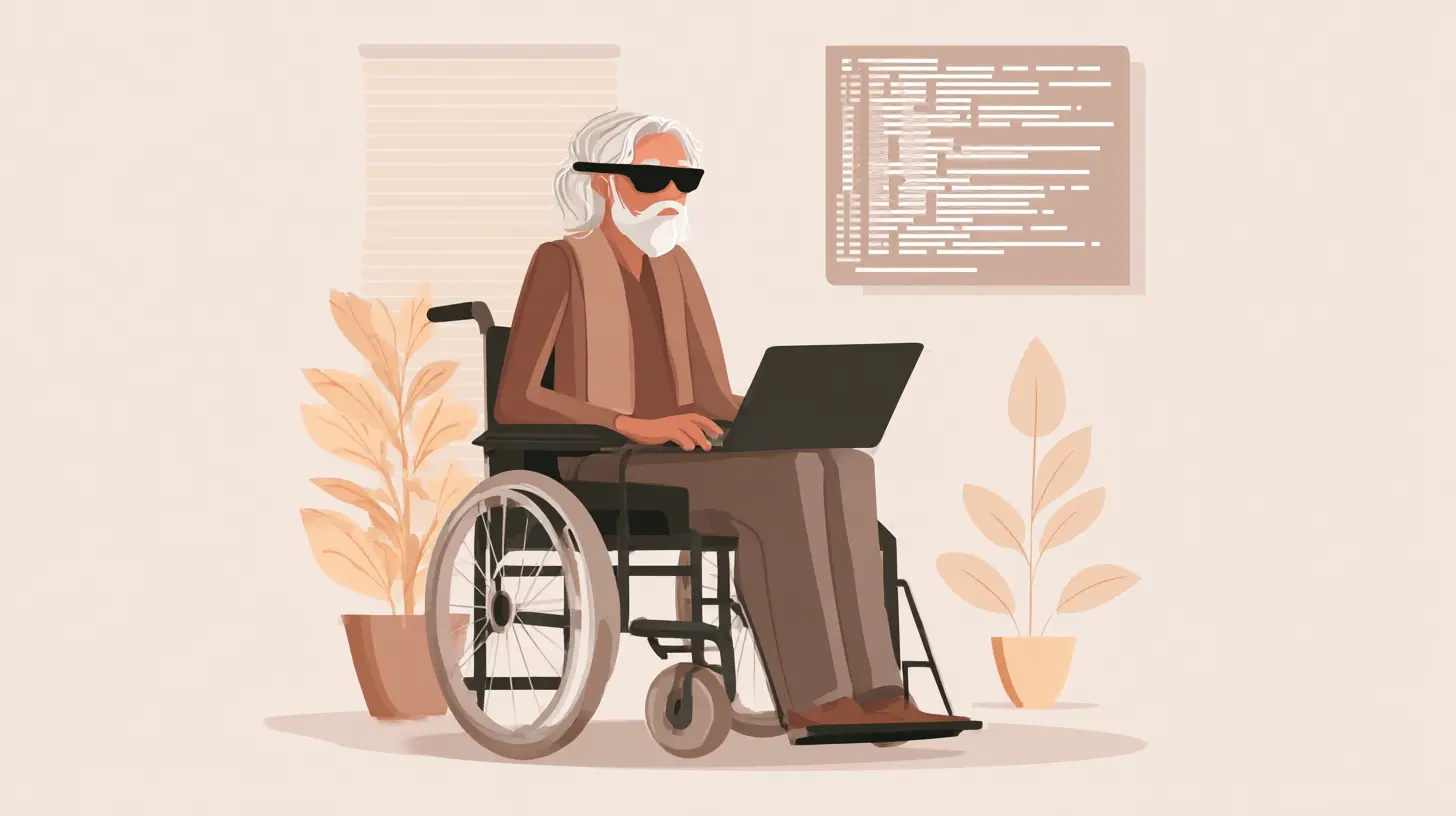
all images in this post were generated using AI tools
Category:
Natural Language ProcessingAuthor:

Marcus Gray
Discussion
rate this article
1 comments
Ian Cole
This article highlights a critical issue in tech today. Leveraging NLP to enhance accessibility for the visually impaired is not just an innovation-it's a necessity. By prioritizing inclusivity, we can create a more equitable digital landscape, ensuring everyone can access information and participate fully in today's tech-driven world.
June 19, 2026 at 2:42 AM
Marcus Gray
I appreciate your insights. It's crucial to focus on inclusivity in tech, and NLP can play a key role in making information accessible for everyone.